

Structured Decision Making (SDM) is a systematic, transparent process for making decisions in situations where there are multiple objectives, competing values, and uncertainty. It blends decision theory and risk-analysis principles with practical tools for collaboration, creating a strategy that is useful for everything from day-to-day project planning to large, multi-stakeholder natural resource management.
In an environmentally focused business, SDM streamlines project management practices—which saves costs, reduces timelines, and minimizes miscommunications—while helping to ensure natural resource management proceeds as effectively and efficiently as possible.
What is Structured Decision Making (SDM)?
At its core, SDM is values-focused thinking. Rather than jumping straight to solutions, the process begins by asking ‘what are we trying to accomplish’ and ‘what do we care about most?’ Only after objectives are clear do we turn to alternatives — the potential ways to achieve those outcomes. From there, the focus shifts to understanding the likely consequences of each option and weighing the tradeoffs among them.
This is not a strictly linear process. SDM is inherently iterative: teams may revisit earlier steps as new information comes to light or as assumptions and constraints are challenged. Sometimes objectives need to be refined, or the problem reframed, before meaningful progress can be made.

By cycling through problem definition, values, alternatives, consequences, and tradeoffs, decision makers and stakeholders can gradually move toward decisions that are transparent, defensible, and aligned with the outcomes that matter most.
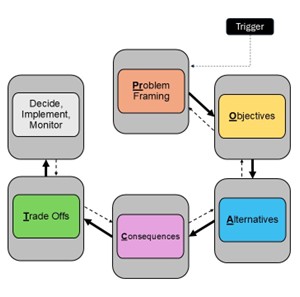
PrOACT Framework: The Five Core Elements of Any Decision
1. Problem Framing: Clearly define the decision and its context. Who is responsible for making the decision(s)? What triggers the decision? What are the constraints? What is the spatial or temporal extent of the problem? Why does it matter?
2. Objectives and Performance Metrics: Identify what you are trying to accomplish from a values-first perspective. Translate those values into measurable attributes or performance metrics that will be used to evaluate alternatives.
3. Alternatives: Only after objectives are clear, develop a broad set of strategies or actions (including status quo or no action). Avoid premature convergence on a single solution.
4. Consequences: Evaluate how each alternative is expected to perform on each objective using data, models, and/or expert judgment. Be clear about assumptions and sources of uncertainty.
5. Tradeoffs: Explicitly examine how alternatives perform across competing objectives, recognizing where gains in one objective come at the expense of another. This step focuses on making values-based choices to understand how much of one outcome you are willing to give up to achieve more of another.
While not part of the PrOACT acronym, the outputs support a transparent decision, followed by implementation, monitoring, and adaptation as conditions change.
Applications of SDM in Natural Resources Management
SDM is flexible and scalable. On the smaller end, project managers can use SDM with clients to frame problems clearly, set objectives, and design efficient work plans. At larger scales, SDM has been used to address complex natural resource challenges where multiple agencies, stakeholders, and values are involved.
One example is the U.S. Department of the Interior and Bureau of Reclamation’s Adaptive Management Program, developed through an SDM process and included as Attachment 2 in their December 2024 report “Long-Term Operation of the Central Valley Project and State Water Project.” This program was designed to guide water operations that support more than 30 million people and over 4 million acres of farmland in California, while balancing ecological and regulatory needs. By applying SDM, the agencies were able to define objectives, evaluate alternatives, and design a transparent adaptive management framework to address one of the most contested water systems in the country.
A second example comes from the Central Flyway Waterfowl Technical Committee, which applied SDM in 2009 to inform the North American Waterfowl Management Plan. Through that process, committee members identified and categorized objectives into use, habitat, and population, which structured their discussions of tradeoffs and priorities. This allowed the group to move from competing interests toward a shared framework for balancing waterfowl conservation with hunting opportunities and habitat management.
More recently, Spheros Environmental applied SDM in rapid-response planning to address invasive zebra and quagga mussels in Washington state. While these mussels have not yet been detected in Washington, the SDM process has allowed agencies to build proactive strategies that can be implemented quickly if a detection occurs, reducing delays, conflict, and costs in the long run.
Key Takeaways
While SDM requires up-front investment in time and facilitation, it ultimately saves effort and resources by reducing conflict, documenting assumptions, and aligning decisions with the values of those most affected. Importantly, SDM does not prescribe the “right” answer — instead, it provides a clear, replicable process to help diverse stakeholders come together to identify the best available path forward. Whether the decision at hand is a narrow operational choice or a high-stakes regional conservation strategy, SDM offers a framework that builds consensus, improves efficiency, and increases confidence in the outcomes.
How Spheros Environmental Applies SDM
At Spheros Environmental, we apply Structured Decision Making (SDM) to a wide variety of natural resource challenges. From local planning efforts to large-scale, multi-agency initiatives, SDM provides a transparent, inclusive, and scientifically grounded way to make choices under uncertainty. By aligning diverse stakeholder values, clarifying tradeoffs, and grounding decisions in the best available data, we help clients move from complex problems to actionable solutions.
About the Author
Dr. Michelle Stantial is a quantitative ecologist with 12 years of experience evaluating the effectiveness of management actions on threatened and endangered species. The focus of Michelle’s career lies at the intersection of quantitative ecology and decision science, aiding managers in navigating problems with multiple, often competing values and uncertainties. Her expertise includes developing spatial capture-recapture models, hierarchical models of animal abundance and occurrence, and decision analysis, and she has collaborated extensively with state and federal agencies, NGOs, and tribal partners to use data-driven decision-making to achieve desirable management outcomes.