

Ethylene oxide (EtO) is a highly reactive, explosive, colorless, and odorless gas commonly used in manufacturing of sterile medical equipment and by other industries. For example, in the United States, EtO is currently used to sterilize 50% of all medical devices.
Using spectroscopic techniques, minimum detection limits are now achievable below 0.5 parts per billion (ppb) at 1-sec time resolution, and as low as single-digit parts per trillion (ppt) with preconcentration and 15-min time resolution (1 ppt is one-thousandth of a ppb). More than ever before, selection of the most appropriate instrument(s) for measuring EtO depends on the intended use case.
In this post, we will discuss three different use-case scenarios: (1) community monitoring, (2) worker safety and exposure monitoring, and (3) industrial process or emissions monitoring.
Ambient Air Monitoring in Communities
General scientific understanding of ambient EtO background concentrations is an active area of research. In recent years, the ability to measure into the sub-100 ppt levels (or sub-0.1 ppb) has permitted observations of more pervasive background EtO levels than previously thought. A key driver of regulations enacted in 2024 and 2025 was the goal of reducing EtO exposures for industrial workers and nearby communities to levels below those corresponding to an estimated lifetime cancer risk of 100 in 1 million. As such, ambient EtO concentrations must be measured at very low levels—i.e., 1-10 ppt. This level of sensitivity is essential for evaluating estimates of community EtO exposures in the context of background concentrations, which are currently understood to vary seasonally; seasonal averages may be as low as 30 ppt or below.
The current regulatory environment for industrial facilities—discussed in a companion post by my colleague, Dana Coe, titled Recent Ethylene Oxide Regulations—underscores the growing need for ultra-sensitive instruments that can differentiate between ambient background concentrations of EtO and industrial emissions.
Worker Safety and Occupational Exposure
Real-time EtO monitoring in occupational environments usually have detection limits on the order of 100 ppb (i.e. 100,000 ppt). These instruments provide real-time information in facility process areas where EtO is regularly used. Meanwhile, many highly sensitive instruments are not certified as ‘intrinsically safe’ for use in an environment where explosive gases could be present. In such environments, instrumentation is limited to photoionization detectors and electrochemical sensors, which usually measure between 100 ppb – 1 ppm (i.e. 100,000 – 1,000,000 ppt) and can have cross-sensitivities to other gases or be influenced by environmental factors.
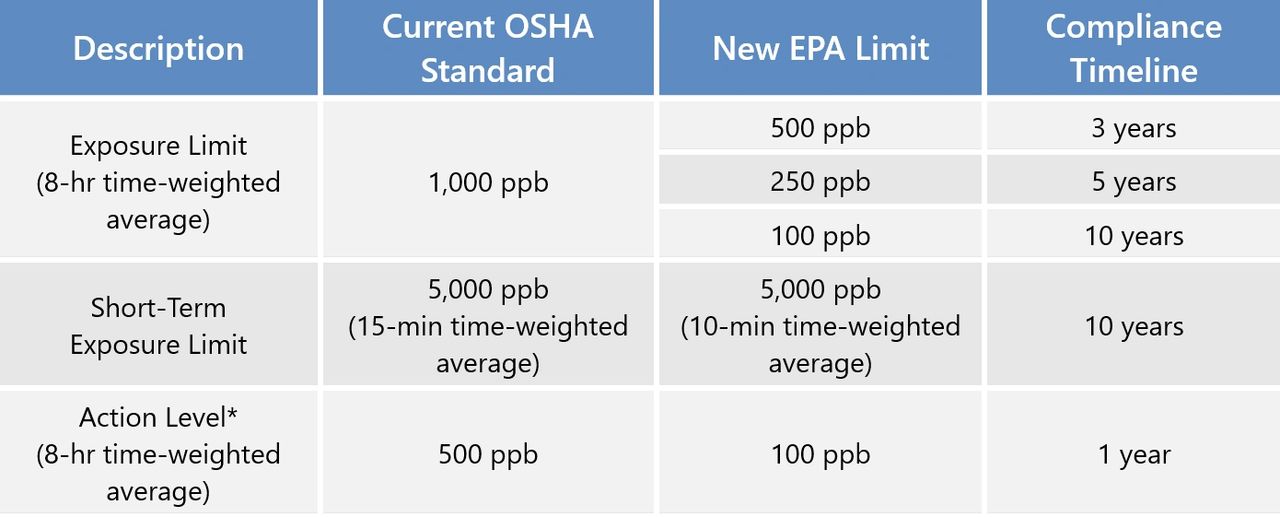
EPA’s January 2025 Interim Decision has tightened worker exposure limits, which will require refined monitoring and compliance approaches. Key changes to the limits and the phased compliance schedule were summarized in the Interim Decision, as shown in Table 1.
Table 1: Summary of Worker Exposure Limit, Short-Term Exposure Limit, and Action Level for EtO commercial Sterilization Facilities (as reproduced from Table 4 of Interim Registration Review Decision for EtO, page 83; with units of measure converted from ppm to ppb).

Process Emission Measurements and Control Efficiency
For facilities that use more than 100 lbs. of EtO per year, EPA’s 2024 National Emission Standards for Hazardous Air Pollutants (NESHAP) regulation requires the use of continuous emissions monitoring systems (CEMS) to demonstrate compliance with the regulation. For this purpose, CEMS must reliably and accurately achieve 90% data capture at facility-specific, process-specific concentration ranges.
Current Measurement Capabilities
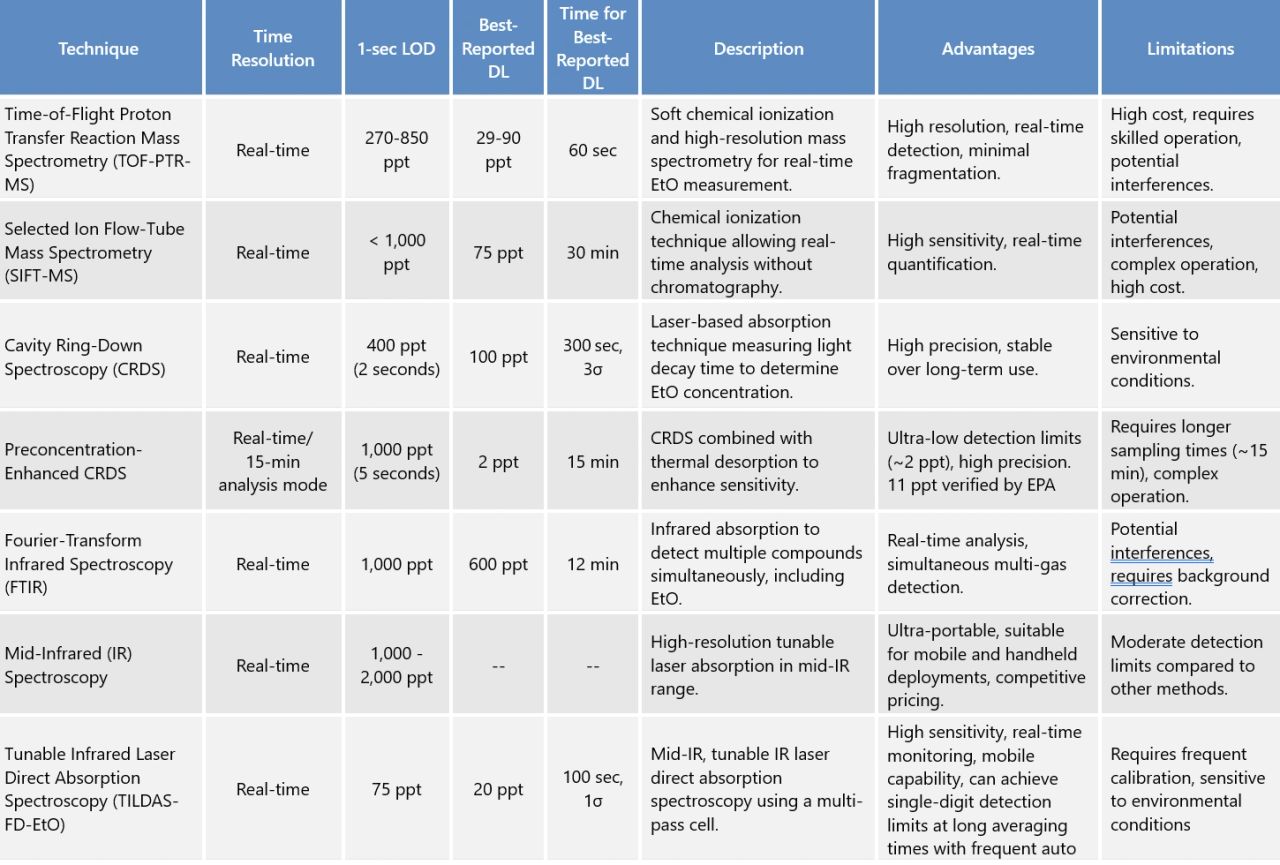
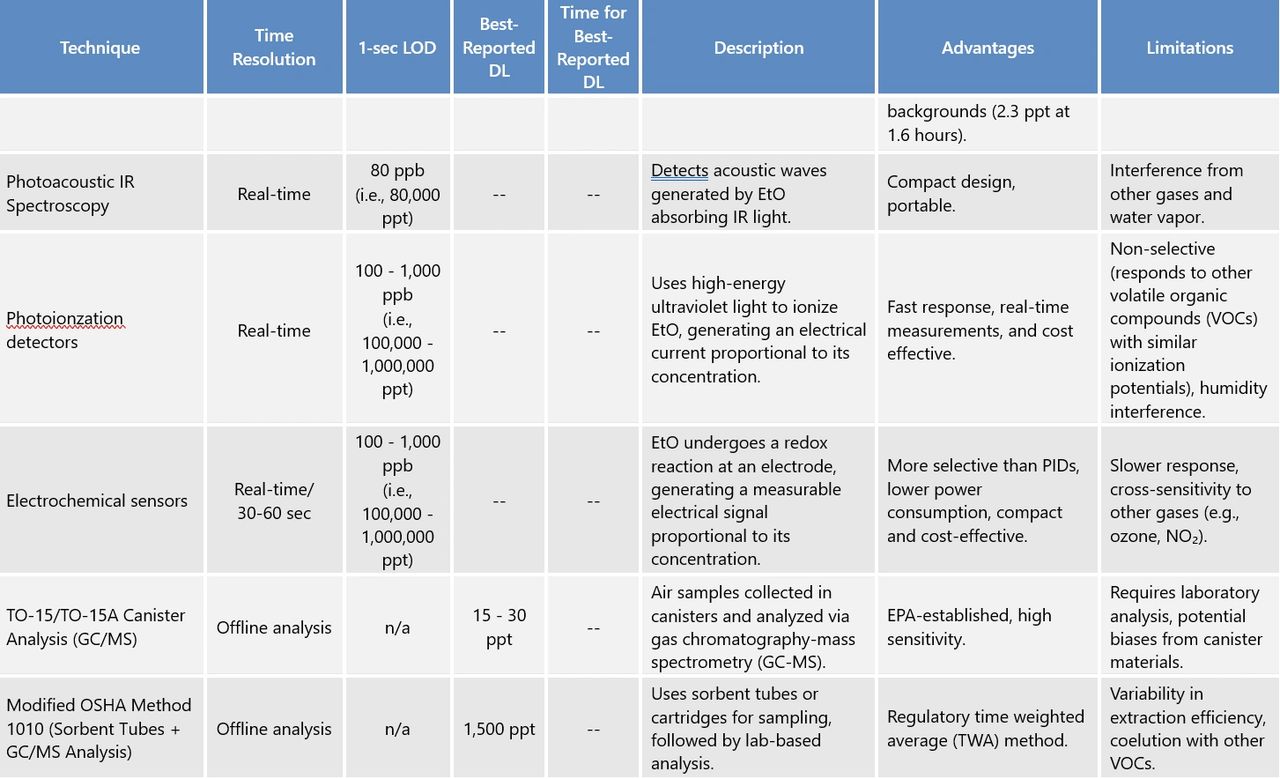
As I mentioned earlier, my colleague previously posted a discussion of available technologies for measuring EtO. Technologies have improved over the past three years, and instruments can now achieve lower detection limits (DL) and better accuracy at higher time resolutions. Current state-of-the-art measurement capabilities are summarized in the table below.
About the Author
Dr. Ethan Emerson’s work spans various areas of atmospheric science, including atmospheric chemistry, methane emissions, physical processes of atmospheric aerosols, instrument development, and research program design. He specializes in statistical approaches to large-scale data analysis and data science. Currently, Dr. Emerson supports Spheros Environmental’s work on advanced measurement platforms for monitoring methane emissions for oil and gas industry clients, government agencies, and community organizations. Before joining Sonoma Technology, Dr. Emerson worked at Colorado State University’s Methane Emissions Technology and Evaluation Center (METEC), where he led programs to advance methane leak detection and quantification technologies both domestically and internationally.
If you have a need related to ethylene oxide monitoring, email Dr. Emerson at ethan.emerson@spherosenv.com.