In February 2024, the U.S. Environmental Protection Agency (EPA) strengthened the primary annual National Ambient Air Quality Standard (NAAQS) for fine particulate matter (PM2.5) from 12.0 micrograms per cubic meter (µg/m3) to 9.0 µg/m3. That change came on the heels of an extensive body of scientific literature linking long-term PM2.5 exposure to premature death, cardiovascular disease, respiratory illness, and other serious health outcomes. EPA’s regulatory impact analysis for the 2024 rule projected that full implementation by 2032 would prevent up to 4,500 premature deaths annually and yield up to approximately $46 billion in public health benefits.
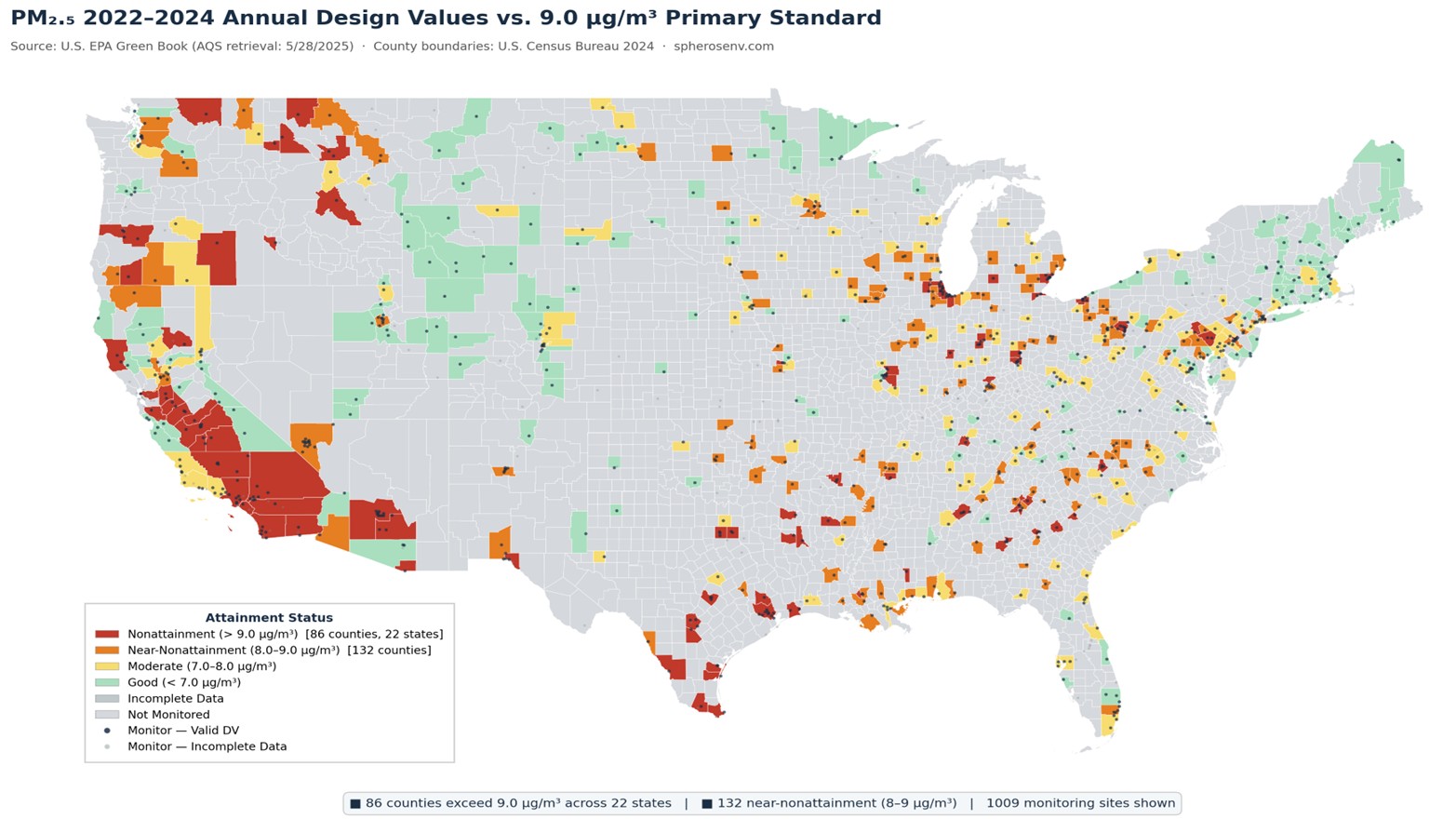
Based on the most recent design-value data from EPA’s Green Book (2022–2024 monitoring period), 86 counties across 22 states have PM2.5 annual design values that exceed 9.0 µg/m3, and an additional 132 counties fall within the near-nonattainment zone between 8.0 and 9.0 µg/m3. The interactive map below shows those areas alongside all 1,040 active monitoring sites in the EPA network.

Coming into Compliance
Under the Clean Air Act, an area designated for nonattainment for an NAAQS must develop and submit a State Implementation Plan (SIP). This document serves as a comprehensive, enforceable roadmap demonstrating how the area will come into compliance. For the 2024 PM2.5 standard, nonattainment area SIPs will be due within 18 months of the effective designation date, which was expected in February 2026. EPA designates nonattainment as Moderate, Serious, Severe, or Extreme. These different levels in turn correspond to different timelines for achieving compliance. For example, areas classified as Moderate nonattainment have up to 6 years from the effective designation date to achieve compliance; areas classified as Serious have up to 10 years.
According to the Clean Air Act, federal transportation funding and approvals for new highway and transit projects in nonattainment areas cannot proceed unless plans are in place demonstrating that projected vehicle emissions will not exceed the vehicle-related emission budgets established in the approved SIP. Within one year of a nonattainment designation becoming effective, the area’s metropolitan planning organization (MPO) and the U.S. Department of Transportation must make conformity determination for the area’s long-range transportation plan and transportation improvement program.
For PM2.5 nonattainment areas, planning organizations must demonstrate that their long-range transportation plans account for direct PM2.5 emissions and precursor pollutants from the on-road vehicle fleet in their area. Projects predicted to result in significant diesel emissions may also be required to undergo quantitative hot-spot analyses using emissions modeling to demonstrate that localized PM2.5 concentrations will remain below the NAAQS.
Changes for New and Existing Sources
In areas currently designated attainment or unclassifiable, the NAAQS revision does not change which sources are subject to the Prevention of Significant Deterioration (PSD) program. However, any source or modification already subject to PSD permitting must now model for compliance with the revised 9.0 µg/m³ standard rather than the previous 12.0 µg/m³ threshold. In practical terms, this situation means more stringent air dispersion modeling requirements for facility expansions and new construction, particularly in areas where ambient PM2.5 concentrations are already near the standard.
In newly designated nonattainment areas, the permitting landscape shifts significantly. New major sources and major modifications become subject to Nonattainment New Source Review, which requires the installation of controls meeting the most stringent standard achievable by the source category, emissions offsets, and alternative siting analysis. The major source threshold in Moderate nonattainment areas remains at 100 tons per year (tpy) for direct emissions of PM2.5 and its precursors. If an area is subsequently reclassified to Serious nonattainment status, the threshold drops to 70 tpy.
For existing permitted facilities in newly designated nonattainment areas, there is no immediate requirement to revise existing permits solely because of the designation. However, nonattainment SIPs must require existing sources to implement Reasonably Available Control Measures (RACM) and Reasonably Available Control Technology (RACT), defined as the lowest emission limitation a source can meet using technology that is economically and technologically reasonable. For PM2.5 Moderate nonattainment areas, RACM/RACT must be implemented no later than four years after the effective date of designation.
Where the Standard Stands Today
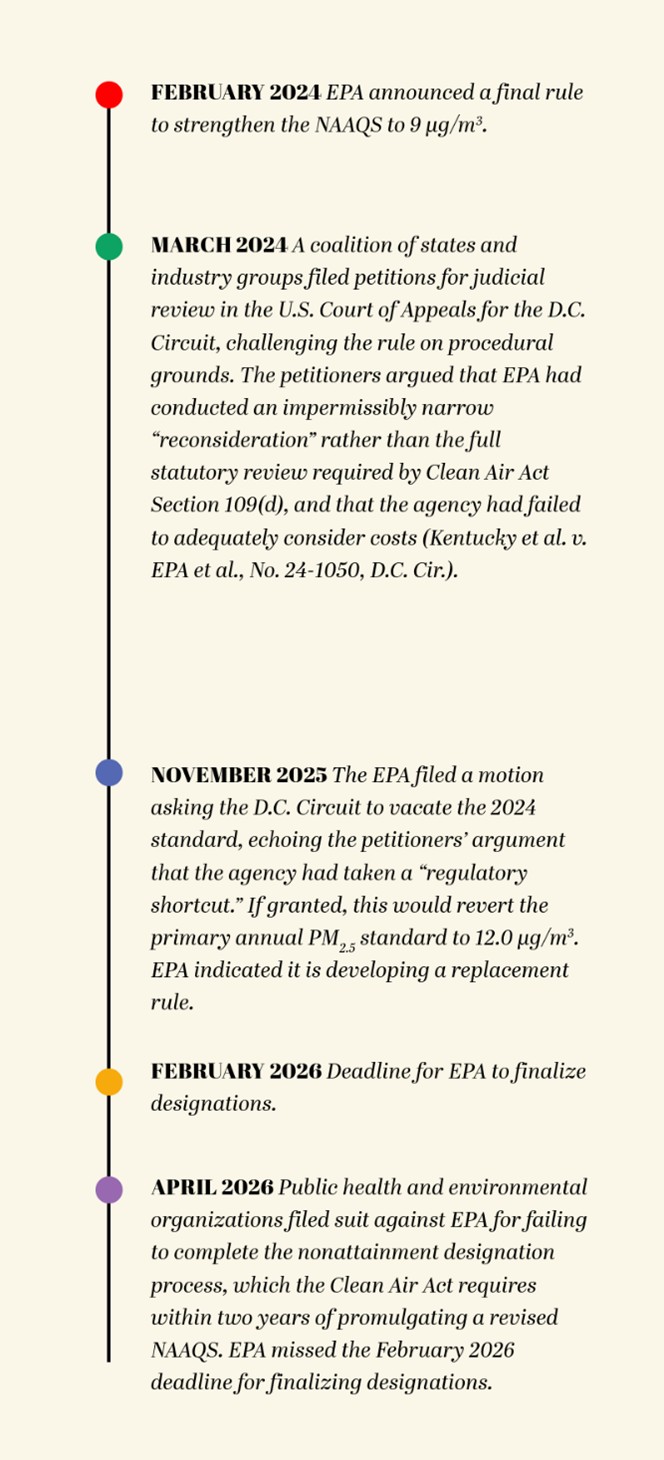
The 2024 PM2.5 rule has been subject to significant legal and administrative activity since its promulgation, as shown in the graphic below, and its ultimate trajectory remains uncertain. However, the standard remains currently in effect.
About the Author
Megan McCabe is an Atmospheric Scientist at Spheros Environmental. Her work focuses on conducting technical analyses using advanced emissions and air quality models to address complex environmental issues and help clients meet regulatory requirements. She is currently working on a range of transportation, litigation, and regional and local air quality modeling projects. Ms. McCabe can be reached at megan.mccabe@spherosenv.com.