
The Challenge
Air quality forecasters rely on large volumes of observed and predicted air quality and meteorological data to develop accurate daily forecasts. Evaluating these inputs across multiple locations, pollutants, and forecast models can be time-intensive, particularly as changing regional emissions affect the relationships between meteorological conditions and air quality.
Forecasters needed a more efficient way to integrate these complex datasets, compare model predictions, account for potential biases, and translate the results into accurate, actionable air quality forecasts.
Our Solution
Spheros Environmental developed AQCast, a web-based air quality forecasting system designed to help forecasters save time and improve the accuracy of their predictions.
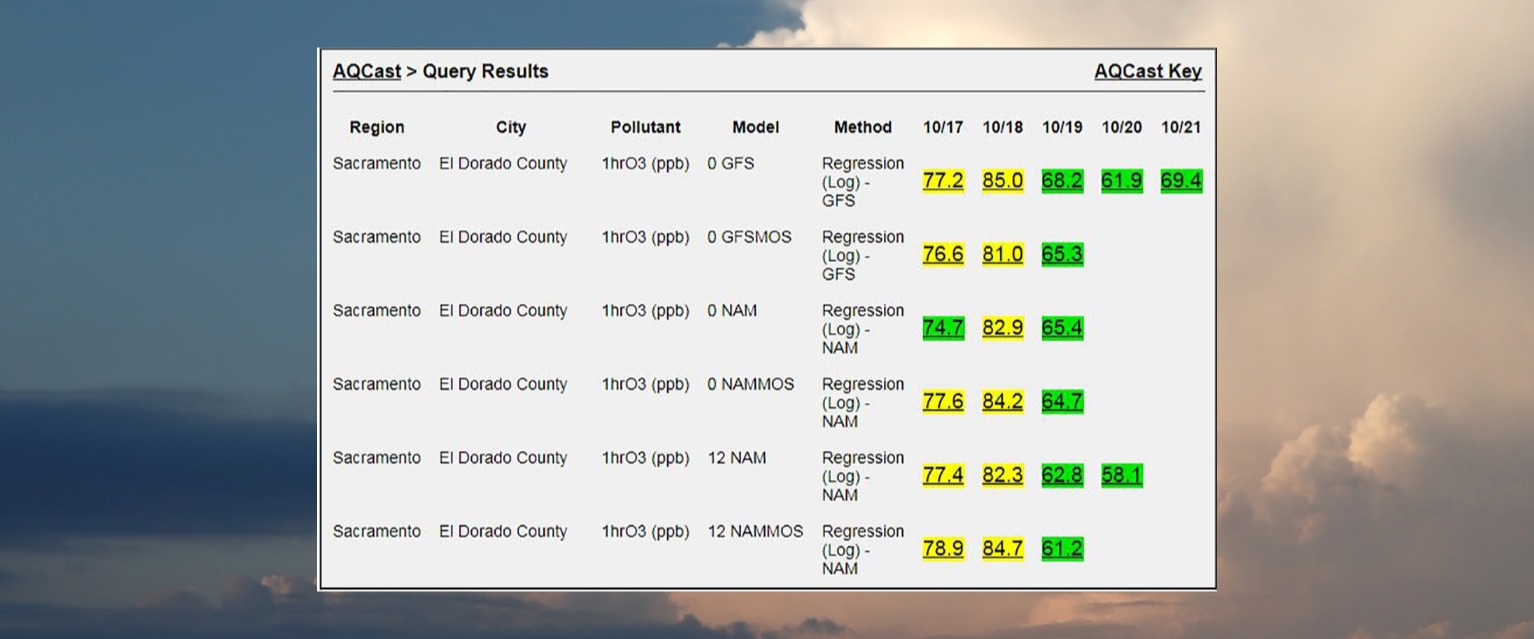
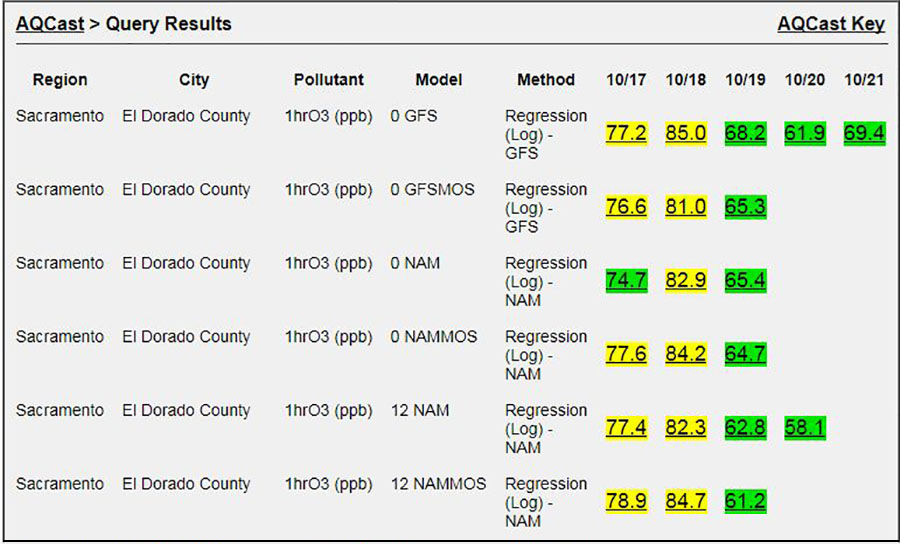
AQCast integrates observed air quality and meteorological conditions with meteorological predictions from multiple forecast models. Through a centralized web interface, users can view air quality predictions by city, pollutant, and model, with results color-coded according to their Air Quality Index (AQI) category.
The system automatically runs daily air quality regression equations and Classification and Regression Trees (CART) to generate predictions. When model inputs are found to be biased, forecasters can manually adjust individual input values and immediately evaluate how those changes affect the forecast.
AQCast was developed using several years of observed air quality and meteorological data. Spheros analysts regularly update the underlying model with new information to account for changes in regional emissions and maintain its usefulness as forecasting conditions evolve.
Air Quality Forecasting and Software Development Consultant
Results +What makes this unique
AQCast brings air quality observations, meteorological data, multiple forecast models, statistical analysis, and data visualization together within a single web-based system, giving forecasters a more efficient way to evaluate the information needed for daily air quality predictions.
The system combines automated regression equations and Classification and Regression Trees with the ability for experienced forecasters to identify biases and adjust model inputs when necessary. This balance of automation and professional judgment helps users refine forecasts rather than relying solely on automated model output.
By combining air quality science, meteorology, statistical modeling, software development, and intuitive data visualization, AQCast demonstrates how purpose-built digital tools can streamline complex environmental forecasting workflows and support more informed air quality predictions.
Project Experts